
Humidity Test Chamber
Controlled Moisture Testing for Your Products with Humidity Test Chambers
ElectroStatica GMBH manufactures high-precision Humidity Test Chambers designed to simulate and control humidity levels over a wide range of temperatures. These chambers are essential for evaluating product behavior under high-moisture conditions — including corrosion resistance, mold growth, insulation degradation, condensation effects, and material expansion.
Our chambers are engineered for continuous accuracy, moisture uniformity, and customizable test cycles, serving a wide spectrum of industries including electronics, defense, packaging, polymers, coatings, and more.
What is a Humidity Test Chamber?
A Humidity Test Chamber creates a controlled environment to expose products and materials to specific levels of relative humidity (RH), often in combination with temperature. This simulates real-world climates such as tropical zones, storage warehouses, marine environments, or manufacturing floors.
Moisture can accelerate corrosion, degrade insulation, alter material properties, or cause electronic malfunctions — making humidity testing crucial during product design, quality control, and certification.
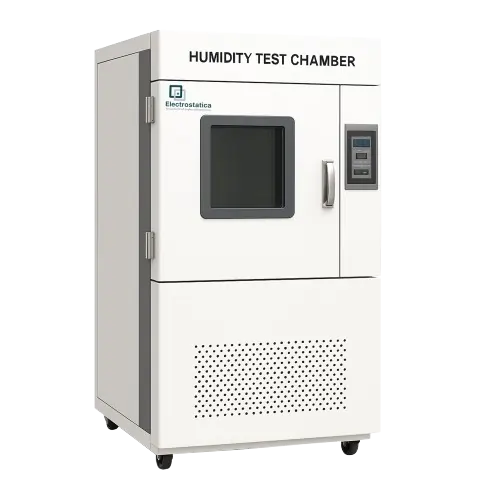
Humidity Test Chamber Features
- Wide Humidity Range:
- 20% to 98% RH, programmable and stable
- Temperature-Humidity Control:
- Standard range: 10°C to 85°C
- Optional extension: 0°C to 100°C with RH control
- Advanced Steam Generator System:
- Ultra-fine vapor distribution for uniform conditions
- RO or distilled water compatibility
- Accurate PID Controller:
- Touchscreen PLC with cycle programming
- RH/Temperature interdependence logic
- Data logging and remote monitoring
- Air Circulation System:
- Cross-flow or vertical airflow for uniform humidity and temperature
- Safety and Alarms:
- Low water level alarm
- Over-temperature/humidity cutoffs
- Door open warning
Use Cases & Applications
Electronics & PCB Testing
- Evaluate insulation resistance under high RH
- Check conformal coating integrity
- Detect failure modes like dendritic growth or leakage
Defense & Aerospace Components
- Validate performance of avionics, optics, and enclosures in damp field environments
- Simulate tropical battlefield and storage conditions
Coating & Paint Industry
- Test adhesion, blistering, and durability of surface coatings under humid conditions
Biotech & Healthcare
- Simulate microbe-friendly environments for mold resistance studies on materials, instruments, or packaging
Packaging & Paperboard Testing
- Evaluate moisture absorption, delamination, and seal integrity of paper, foil, and polymer packaging
Polymer, Rubber, and Composites
- Understand moisture absorption and material expansion behavior over time
Compliance & Standards
Our Humidity Chambers help meet the following international testing standards:
- IEC 60068-2-78 – Damp Heat (Steady State)
- MIL-STD-810H Method 507.6 – Humidity
- JEDEC JESD22-A101 – Steady-State Humidity Life Test
- ASTM D2247 – Water Resistance of Coatings
- IS 9000 Part V – Humidity Testing of Electrical Items
- FDA / WHO / BIS Requirements – Packaging & Biostability Studies
Custom Options Available
- Humidity-only or temp+humidity combo modes
- High-altitude or low-pressure integration
- Glass viewing window with anti-condensation heater
- Additional feedthroughs for power or sensor cables
- Stainless steel shelves, datalogger printers, or 21 CFR Part 11 options
Our Products
Humidity Test Chamber Specifications
| Temperature Range | 10°C to 85°C (optional: 0°C to 100°C) |
| Humidity Range | 20% to 98% RH |
| Humidity Accuracy | ±2.5% RH |
| Temp Accuracy | ±0.3°C |
| Volume Options | 100L / 250L / 500L / 1000L / 1500L Walk-in (customized) |
| Humidification System | Steam generator or ultrasonic humidifier |
| Dehumidification | Condensation or desiccant-based |
| Construction | SS304 interior powder-coated or SS exterior |
| Controller | HMI touchscreen with PLC |
| Data Interface | USB Ethernet RS-485 Modbus |
| Safety Features | Over-temp low water dry run glass heater for viewing window |
| Power Supply | 230V / 50Hz or 415V / 50Hz (model-specific) |
Why Choose ElectroStatica GMBH?
- Built for industrial-grade accuracy & long-term stability
- Available in reach-in, walk-in, or custom enclosures
- Full installation, validation (IQ/OQ/PQ), and AMC support
- CE-marked and export-ready designs
- Continuous data recording with real-time alerts
Frequently Asked Questions (FAQ)
What is a humidity test chamber used for?
A humidity test chamber is a controlled environment device used to evaluate how products, materials, or components respond to varying levels of moisture and temperature. Industries such as electronics, automotive, aerospace, pharmaceuticals, and packaging rely on these chambers to simulate real-world climate conditions, helping manufacturers understand how humidity affects performance, durability, corrosion resistance, and overall product lifespan before items reach the market.
How does a humidity test chamber work?
The chamber works by precisely regulating internal temperature and relative humidity using a combination of heating elements, refrigeration systems, humidifiers, and sensors. Water is typically vaporized and introduced into the chamber while temperature controls maintain a stable environment. A closed-loop control system continuously monitors conditions and makes micro-adjustments to keep humidity and temperature levels within the programmed test parameters, ensuring consistent and repeatable results throughout the testing period.
What is the difference between a humidity chamber and a climate chamber?
While the terms are sometimes used interchangeably, a humidity chamber typically focuses on controlling temperature and moisture levels within a defined range, often used for standard damp heat or condensation testing. A climate chamber, on the other hand, usually offers a broader range of environmental simulation capabilities, including extreme temperatures, altitude simulation, or combined stress testing. Essentially, all climate chambers can perform humidity testing, but not all humidity chambers offer the full range of climate simulation features.
What industries commonly use humidity test chambers?
Humidity test chambers are widely used across electronics manufacturing to test circuit boards and devices for moisture resistance, automotive industries to assess component durability under varying weather conditions, pharmaceutical companies to determine drug stability and shelf life, packaging industries to evaluate material integrity, and aerospace sectors to ensure components can withstand extreme environmental fluctuations during flight or storage.
How long does a typical humidity test take?
Test duration varies significantly depending on the testing standard, product type, and purpose of the evaluation. Some tests, such as quick condensation or damp heat cycles, may last only a few hours, while long-term reliability or accelerated aging tests can run continuously for several days or even weeks. The specific duration is usually determined by industry standards, such as those set by ASTM, IEC, or MIL-STD specifications, along with the manufacturer’s own quality assurance requirements.